Tim O’Neal
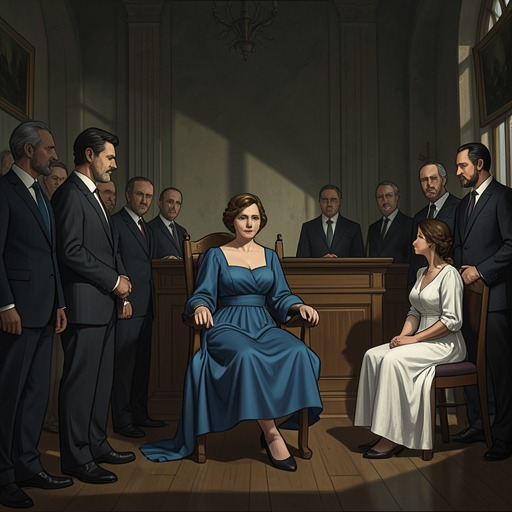
Where the Crawdads SingTim O’Neal is a longtime shrimp-boat captain and the final witness called by Tom Milton at Kya Clark’s murder trial. He confirms seeing a boat near Barkley Cove Harbor around the time Chase Andrews died, but refuses to identify it as Kya’s. His testimony makes the limits of eyewitness identification central: presence on the water is not the same as proof of who was aboard.
Identity and Background
Tim has operated his own shrimping boat in the waters off Barkley Cove for thirty-eight years. Nearing sixty-five at the time of the trial, he is described as tall but stout, with thick brown hair touched by gray and a nearly white beard. His long experience gives his testimony practical authority: he knows the local waters and has encountered the kind of boats under discussion repeatedly.
That authority is also framed through his standing in the community. People regard him as quiet, serious, honest, and gracious, with the courteous habit of opening doors for women. Tom Milton sees him as an ideal final witness, calling him when only one witness remains. The courtroom introduction therefore establishes both his relevant expertise and the personal reputation on which the force of his account may depend.
Testimony at the Trial
Tom asks Tim to confirm that he was steering his boat into Barkley Cove Harbor between approximately 1:45 and 2:00 a.m. on the night of October 29–30, 1969. Tim confirms the timing. He is also aware that Hal Miller, who testified, and Allen Hunt, who provided an affidavit, said they had seen Kya Clark motoring north past the harbor at approximately that time.
Tim confirms that he saw the same boat Miller and Hunt described, but rejects their identification of its occupant. He says he did not recognize Kya in it. His distinction is exact: he does not deny that a boat was there or that it was headed north; he denies that he could tell who was operating it. His account thus supports one part of the witnesses’ claim while withholding the conclusion that would connect the boat to Kya.
Asked to explain, Tim points to the conditions and the distance. It was dark, there was no moon until later, and the boat was too far away for certain recognition. He says that he had seen Kya in her boat many times and had previously known it was hers straight away, but on this occasion he could not identify either the boat or its boater with certainty. Familiarity, in his account, does not overcome what the night made impossible to see.
The Boat and the Limits of Identification
On redirect, Tom confirms that Tim had recognized Kya’s boat on other occasions but saw nothing that identified this boat or its operator as hers that night. Tim agrees. He adds that boats of the same size and shape as Kya’s are common in the area. That detail matters because resemblance, even combined with a northbound course and a relevant time, cannot establish a unique identity when many local boats fit the description.
The testimony is careful about what remains known and unknown. Tim’s experience helps him describe the local boating context, but it does not allow him to turn an indistinct sighting into a personal identification. His evidence does not establish who was in the boat; nor does the excerpted testimony establish what became of the separate possibility raised in questioning. The narrative preserves that boundary rather than making his certainty exceed the conditions he describes.
Narrative and Trial Significance
As Tom Milton’s last witness, Tim gives the defense a closing piece of testimony with a narrow but consequential function. The earlier witnesses’ accounts place a boat resembling Kya’s on the water; Tim independently confirms seeing a boat at the relevant time, while refusing to confirm that it was hers. The same observation that might appear to strengthen the identification instead exposes its uncertainty.
Tim’s role rests less on a dramatic revelation than on disciplined qualification. His prior ability to recognize Kya’s boat makes his inability to do so on this occasion meaningful, while the darkness, distance, and prevalence of similar boats explain why he will not claim more. The result is a distinction between sighting and identification that keeps the prosecution’s account from being treated as settled by this witness. The testimony adds evidence about the boat’s presence, but leaves the crucial question of its operator unresolved.